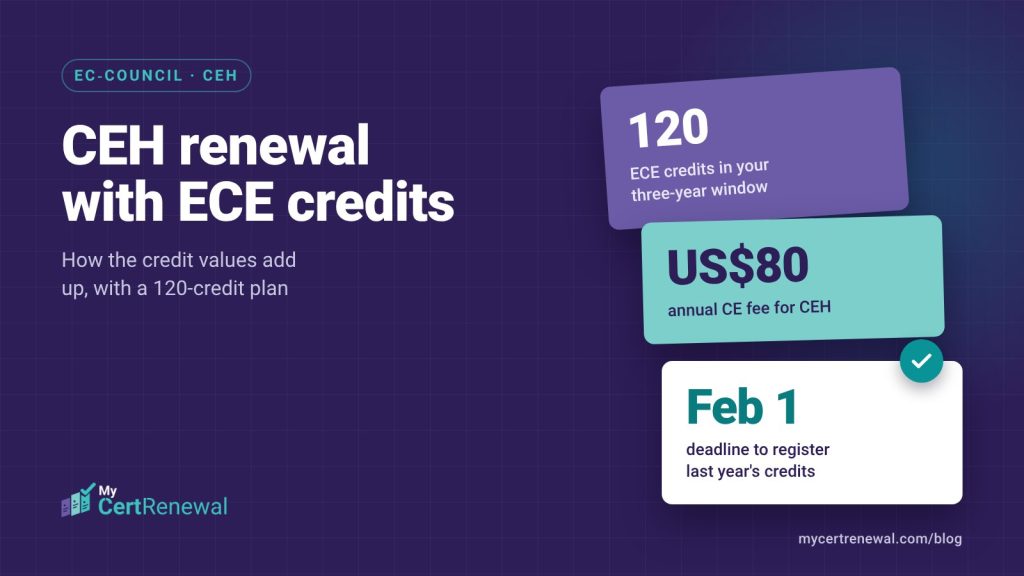
To renew CEH, you need 120 ECE credits within your three-year window, registered in EC-Council’s Aspen portal, and you need to keep paying the annual CE fee, which is US$80 for CEH. Credits are counted by calendar year and must be registered by February 1 of the following year, according to EC-Council’s CPE (ECE) Policy.
Our EC-Council ECE credits guide covers the scheme as a whole. This post turns the credit table into a CEH plan and covers two ways a renewal stalls even when you have the credits: an unpaid fee and late registration.
The CEH renewal rules in one list
- 120 credits per certification within its three-year window. If you hold more than one EC-Council certification, credits are applied across all of them, but since January 1, 2013 each certification has its own window and its own requirement.
- Calendar-year registration: credits earned January 1 to December 31 must be registered by February 1 of the next year.
- One window only: an activity must be completed inside the window and submitted in only one three-year window.
- IT security only: only IT security related events qualify.
- Not your day job: EC-Council says credits are not awarded for activities related to your job role.
- Evidence: you must keep sufficient evidence of your involvement in each activity.
The annual CE fee is part of renewal
EC-Council’s Continuing Education Fees page lists the CEH and CEH (Practical) annual CE fee as US$80. Fees are payable annually from the date you earned the certification, so the due date follows your cycle, not the calendar year.
Paying the fee does not renew CEH on its own. EC-Council says recertification needs both the credits and the fee. If you miss a fee due date, your expiry date is not extended and you can’t add ECE credits in Aspen until you pay. That bites hardest in January, when you need Aspen open to register last year’s credits by February 1.
What earns credits: the values that matter for CEH
EC-Council’s policy page gives a credit value for each activity type. These are the ones a working CEH holder is most likely to use:
| Activity | Credits listed |
|---|---|
| Passing an EC-Council exam in the ECE scheme | 120 |
| Certification examination related to IT security | 40 |
| Passing a non-ECE EC-Council certification (such as CSCU) | 40 |
| Authoring an article, book chapter or white paper | 20 |
| Higher education, per semester / per quarter | 15 / 10 |
| Identifying a new vulnerability | 10 |
| Reading an information security book, article review, book review or case study | 5 |
| Association or organization chapter membership (per association) | 3 |
| Presentation | 3 |
| Association or organization membership (per association) | 2 |
| Chapter meeting (per meeting) | 1 |
| Education course; education seminar, conference or event | 1 |
The last row needs a check. The policy lists a course or a conference at 1 credit without saying whether that is per hour, per day or per event, so confirm how Aspen values the entry before you count on a conference.
The top row is the big one. EC-Council says the 120-credit value applies only to passing a certification in the ECE scheme, such as CHFI or CND. Passing one of those during your CEH window can count for the full 120.
A sample 120-credit CEH plan
Here is one way the listed values reach 120 over three years. It uses only activities with a clear unit and leaves out memberships, because the policy doesn’t say how often each one can be claimed. EC-Council decides each entry in Aspen, so treat this as a worked example.
| Activity | Count | Credits |
|---|---|---|
| Pass one IT security certification exam | 1 | 40 |
| Write and publish one security article | 1 | 20 |
| Read and review security books | 5 | 25 |
| One semester of a relevant college course | 1 | 15 |
| Attend local chapter meetings | 12 | 12 |
| Give presentations | 3 | 9 |
| Total | 121 |
Because credits are registered by calendar year, aim for roughly 40 a year and register them each January. Anything over 120 is a buffer in case an entry is not accepted.
Your annual CEH checklist
- Each January: list everything you completed last year and register the qualifying entries in Aspen before February 1.
- Before your certification anniversary: pay the annual CE fee so the expiry date extends and Aspen stays open for new credits.
- After each activity: save the proof straight away, along with a note on why it is IT security content and not part of your job role.
- Six months before the window closes: compare your Aspen total with 120 and book whatever closes the gap.
Miss the requirement and the certification is suspended. You are reinstated if you reach 120 credits within 12 months of the window ending and your CE fee is paid, but your next window is shortened by the suspension period. Miss that too and the certification is revoked; to get it back you have to retake and pass the new exam. Appeals must reach EC-Council in writing within 90 days of the suspension or revocation notice.
Where MyCertRenewal fits
MyCertRenewal has EC-Council credit rules built, alongside ISC2, CompTIA and ISACA (see supported certifications). You log an activity once and see where it can count toward CEH and the other certifications you hold. If an activity doesn’t qualify for CEH, it is marked not eligible with the reason recorded. CE fees are tracked on each renewal cycle, with a reminder before the cycle ends (see Your renewal cycles). You still register credits in Aspen yourself.
Holding CEH alongside CISSP or Security+? Our guide on counting one activity toward several certifications shows how the same conference can land differently at each certifying body.
Want your CEH window, CE fee and credits in one view? Start free with up to 2 certifications, no card needed.
Frequently asked questions
How many ECE credits do I need to renew CEH?
120 credits within your three-year window, according to EC-Council’s CPE (ECE) Policy. Credits are earned by calendar year and must be registered in Aspen by February 1 of the following year.
How much is the CEH annual CE fee?
EC-Council’s Continuing Education Fees page lists US$80 a year for CEH and CEH (Practical). Fees are payable annually from the date you earned the certification.
Does paying the CE fee renew CEH?
No. EC-Council says recertification needs both the 120 credits and the annual CE fee. If the fee is unpaid, you also cannot add ECE credits in Aspen until it is paid.
Can my normal job count toward CEH credits?
No. EC-Council’s policy says ECE credits are not awarded for activities related to your job role, and only IT security related activities qualify.
Does a conference count as 1 ECE credit per hour?
The policy page lists an education seminar, conference or event at 1 credit without stating the unit. Check how the Aspen portal values the entry before you rely on it.
Certification rules change. Always confirm current requirements with the certifying body. MyCertRenewal is not affiliated with EC-Council.